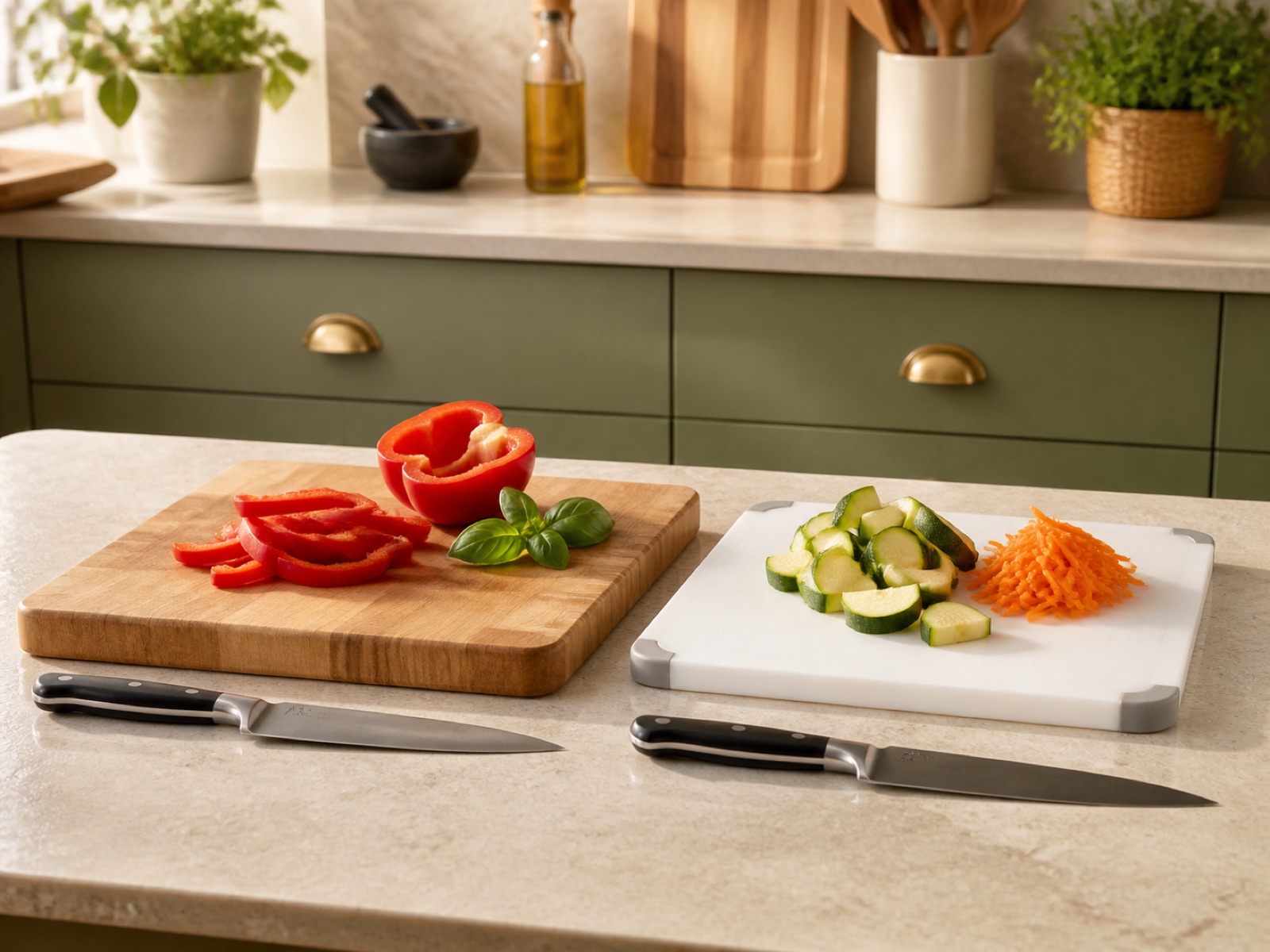
Choose wood for a stable, knife-friendly everyday preparation surface if you will hand-wash, dry and maintain it. Choose plastic for raw meat, easy colour separation and dishwasher cleaning. For many kitchens, the best answer is one substantial wooden board plus one dishwasher-safe plastic board kept for raw meat, poultry and fish.
The material alone does not make a chopping board hygienic. A clean, intact board used with a sensible separation routine is safer than a neglected board of either type. Deep grooves, cracks, trapped moisture and moving from raw meat to ready-to-eat food without thorough cleaning are the problems to control.
This guide compares wood and plastic by hygiene workflow, knife friendliness, cleaning, stability, maintenance and replacement. It does not rank individual products or present manufacturer descriptions as hands-on test results.
Wood vs plastic chopping boards at a glance
| Question | Wood | Plastic |
|---|---|---|
| Best role | Everyday vegetables, bread, herbs and cooked foods | Raw meat workflow, colour separation and low-maintenance prep |
| Knife friendliness | Good hardwood is generally gentle on edges | Usually reasonable, although surface hardness varies |
| Cleaning | Normally hand-wash and dry promptly | Many models are dishwasher safe; check the label |
| Maintenance | May need food-safe oil or board conditioner | No oiling; inspect for grooves and warping |
| Stability | Thick, heavy boards can feel very secure | Light boards may need feet or a damp cloth underneath |
| Moisture | Can warp or split if soaked or dried unevenly | Non-porous but can warp under heat if not dishwasher rated |
| Wear | Cut marks, drying, cracks or joint separation | Deep cut grooves, roughness, staining or warping |
| Storage | Needs air circulation and space to dry | Often thin and easy to store or colour code |
| Typical lifespan | Potentially long with suitable care | Replace when excessively worn or hard to clean |
Which material is more hygienic?
There is no useful one-word winner. Current USDA Food Safety and Inspection Service guidance says consumers may use either wood or a non-porous board such as plastic. It notes that non-porous surfaces are easier to clean, while both materials should be replaced once excessively worn or marked by hard-to-clean grooves.
UK Food Standards Agency guidance focuses on the workflow: do not use the same board or knife for raw meat or poultry and ready-to-eat food unless they have been thoroughly cleaned and disinfected between uses. The FSA’s research on real kitchens also found that boards used for raw meat were often not properly decontaminated before reuse.
That means a dishwasher-safe plastic board has a practical advantage for raw food in many homes, but it does not remain safe when deeply scarred, left dirty or used across tasks. A wooden board can be part of a hygienic routine when it is sound, cleaned correctly and allowed to dry fully.
Choose wood for stability and everyday knife work
A substantial hardwood board provides a broad, stable platform and a surface that is generally kinder to a sharp knife than glass, stone or metal. Its weight can help it stay planted while you chop. It can also be left on the worktop as a permanent prep station if it has room to dry and is not used as an uncontrolled landing place for shopping bags, post or dirty utensils.
Wood asks more of its owner. Most wooden boards should not be soaked or put in a dishwasher. Prolonged water and dishwasher heat can swell fibres, open joints, warp the board or damage the finish. Wash it according to the maker’s instructions, dry it promptly and store it so air reaches both faces.
Some boards need periodic treatment with a food-safe mineral oil, wax or board conditioner. Use the product recommended for the board. Cooking oils such as olive or sunflower oil may turn rancid and are not a universal substitute. Stop using a board with deep cracks, loose pieces or separated glue lines that cannot be cleaned reliably.
Choose plastic for easy separation and dishwasher cleaning
Plastic boards are light, relatively inexpensive and easy to assign to a specific task. A clearly marked board for raw meat can be moved straight to the dishwasher after use if the exact model is dishwasher safe. Colour can help a household remember the system, although the colour has no protective effect by itself.
The weak point is wear. Knife cuts can develop into deep grooves that retain debris and become difficult to clean. A board that rocks after heat exposure or slides across the counter also creates a control problem. Replace plastic when it is excessively scarred, rough, warped or no longer cleanable, not only when it breaks.
Very thin mats save storage space but can curl or move. If you choose one, it should lie completely flat and remain stable in use. A rigid board with non-slip feet or enough area for a damp cloth underneath is often easier to control.
The safest practical setup: separate raw and ready-to-eat food
Keep one board for raw meat, poultry and fish and another for vegetables, fruit, bread and foods that will not receive further cooking. This reduces the chance of transferring bacteria from raw animal products to salad, bread or cooked food.
Turning a dirty board over is not reliable separation. Hands, worktops, rims and handles may already have been contaminated, and juices can reach the second face. The raw-food board should be removed and cleaned immediately. Wash hands and clean any knife, worktop or utensil that has contacted the raw food before continuing.
If you have only one board, prepare ready-to-eat foods first. Then use the board for raw food and thoroughly clean and, where required, sanitise or disinfect it according to official guidance and the board maker’s instructions before its next use. A quick wipe with a cloth is not equivalent to washing.
Cleaning, sanitising and drying
Cleaning removes grease, food and some microbes. Sanitising or disinfecting is a separate step used to reduce or destroy microorganisms, and it works best after visible soil has been cleaned away. Use only a product approved for food-contact surfaces and follow its concentration, contact time and rinsing instructions. Do not improvise chemical mixtures.
For a wooden board
- Remove food residue promptly.
- Wash both faces and the edges by hand using the method the manufacturer specifies.
- Rinse without prolonged soaking.
- Dry with a clean towel, then stand the board where air can circulate around it.
- Condition only when required and with a suitable food-safe product.
- Never put it away damp against a worktop or wall.
For a plastic board
- Scrape food into the bin without dragging a sharp knife edge sideways.
- Use the dishwasher when the label permits and the board fits without obstructing the machine.
- Otherwise wash thoroughly with hot, soapy water and rinse.
- Air-dry or dry with a clean disposable towel after raw-food use.
- Inspect deep grooves and rough areas in good light.
- Replace a warped board that will not sit flat.
End-grain, edge-grain and face-grain wood
These labels describe how the wood fibres are oriented. End-grain boards show the ends of the fibres and often use a block pattern. Edge-grain boards expose the long edge of strips, while face-grain boards use the wider face.
End-grain is commonly valued for a forgiving cutting feel and substantial construction, but it can be heavy and expensive and contains many glued joints. Edge-grain can offer a useful balance of price, durability and manageable weight. Quality of timber, drying, adhesive, construction and care matter more than treating one orientation as automatically superior.
What about bamboo and paper composite?
Bamboo boards are made from bonded strips of a fast-growing grass. They are often hard, light and relatively moisture resistant, but resin content and construction vary. Check knife-care, dishwasher and oiling instructions for the exact product rather than assuming bamboo behaves like hardwood.
Paper-composite boards use compressed fibres and resin. Some are thin, dishwasher safe and resistant to heat, creating a middle ground between traditional wood and plastic. Those properties are product-specific: verify the food-contact approval, dishwasher limit, heat rating and maintenance guidance.
Avoid glass, stone and metal for routine chopping
Glass, granite, marble and metal are easy to wipe, but they are very hard on knife edges and can feel slippery or noisy. They are better treated as serving or pastry surfaces unless specifically required for another task. A surface that rapidly dulls your knife can also reduce cutting control.
If protecting a sharp edge matters to you, pair your board decision with our guide to choosing between a chef’s knife and a santoku.
Size, thickness and stability
Your board should be larger than the food and long enough for the full blade to move without hitting the rim. A cramped board allows chopped food to fall off and encourages the knife to work near the edge. Around 30–40cm in length is a useful medium range for many kitchens, but measure your worktop, sink and dishwasher before buying.
A heavier, thicker board is generally more stable but harder to lift, wash and dry. If you cannot comfortably move a large wooden board to the sink, a permanent worktop board plus a smaller washable raw-food board may be more realistic.
The board must not slide. Built-in rubber feet can help but may prevent using both sides. A clean damp cloth or purpose-made non-slip mat underneath a flat board can improve grip; keep it away from the food surface and wash it after use.
Do you need a juice groove?
A groove can contain modest amounts of juice from a roast, tomatoes or fruit. It also reduces the flat working area and creates another channel to clean. Choose it for genuinely juicy tasks, not as a sign of quality. The groove is not a substitute for a tray when a large joint releases more liquid than the board can hold.
Environmental claims need context
Wood is renewable when responsibly sourced, while plastic uses fossil resources and can shed material as it wears. That does not make every wooden board the lower-impact purchase. Timber source, adhesives, manufacturing, shipping, maintenance products, lifespan and end-of-life options all matter. A durable board used for years may be preferable to repeatedly replacing a poor product, whatever the material.
Look for specific evidence such as recognised forestry certification, recycled-content details and local recycling instructions. Avoid treating vague words such as “eco”, “natural” or “recyclable” as a complete assessment.
Which setup should you buy?
Buy wood first if most of your prep is vegetables, bread, herbs and cooked food, you value a stable knife-friendly surface, and hand washing and occasional conditioning fit your routine.
Buy plastic first if you need dishwasher cleaning, prepare raw meat regularly, have limited storage or want an inexpensive board that is easy to assign to one food category.
Buy one of each if you want the least-compromised system: a large wooden board for daily plant and ready-to-eat preparation, plus a clearly marked dishwasher-safe plastic board for raw animal products.
Buying checklist
- Is the usable area larger than your knife and regular ingredients?
- Will it fit your sink or dishwasher?
- Can you lift, wash and dry it safely?
- Does it stay flat and stable on your worktop?
- Is it clearly assigned to raw or ready-to-eat food?
- Are the dishwasher, sanitising and oiling instructions explicit?
- Is a groove useful, or would you prefer more flat space?
- Can both faces and edges dry with air circulation?
- What wear does the manufacturer say requires replacement?
- Do you have space for a second board to simplify separation?
The Completely Tasty verdict
Wood is the better everyday cutting surface for cooks who value stability, knife care and long-term use and who will maintain it properly. Plastic is the better low-maintenance tool for raw-food separation and dishwasher cleaning. Neither remains hygienic when deeply damaged or poorly cleaned.
For most mixed households, use both: a comfortable wooden board for vegetables, bread and cooked foods, and a dishwasher-safe plastic board reserved for raw meat, poultry and fish. The routine is more important than winning an argument about material.
Frequently asked questions
Are wooden chopping boards safe for raw meat?
Official USDA guidance allows wood or non-porous boards for raw meat, but separation and thorough cleaning are essential. In practice, many households find a dishwasher-safe plastic board easier to dedicate to raw meat.
Are plastic boards more hygienic than wood?
Plastic is non-porous and often easier to wash in a dishwasher, but deep grooves become difficult to clean. Material alone does not decide hygiene; condition, separation, washing and drying do.
Can a wooden chopping board go in the dishwasher?
Usually not. Heat, water and detergent can warp, split or delaminate wood. Follow the exact board’s instructions; hand washing and prompt drying are the normal approach.
When should I replace a plastic chopping board?
Replace it when it is excessively worn, develops hard-to-clean grooves, becomes rough or will no longer sit flat. Do not wait for it to crack completely.
How often should I oil a wooden board?
There is no universal timetable. Climate, washing frequency, timber and finish all matter. Follow the maker’s instructions and condition the board when it looks dry or absorbs water unevenly, using a suitable food-safe product.
Is bamboo better than wood or plastic?
It is a separate compromise: often hard, light and moisture resistant, but construction and resin vary and the surface may feel harder on knives. Check the exact care and dishwasher guidance.
Can I use both sides of one board for different foods?
Using opposite faces is not reliable separation if the board, hands, rim or worktop are contaminated. Dedicated boards are clearer. Thoroughly wash and dry the whole board between raw and ready-to-eat tasks.
What is the best chopping board for sharp knives?
A well-made hardwood, suitable plastic or blade-friendly composite is preferable to glass, stone or metal. Stability, surface condition and correct knife technique still matter.
Research note
This guide was checked against current guidance from the UK Food Standards Agency on separating raw and ready-to-eat food, the FSA’s research on chopping-board reuse, the USDA FSIS cutting-board guidance and Victorinox UK material and care guidance. The instructions supplied with your board and cleaning products take priority.
Continue exploring our kitchen Buying Guides for practical comparisons built around how you cook.