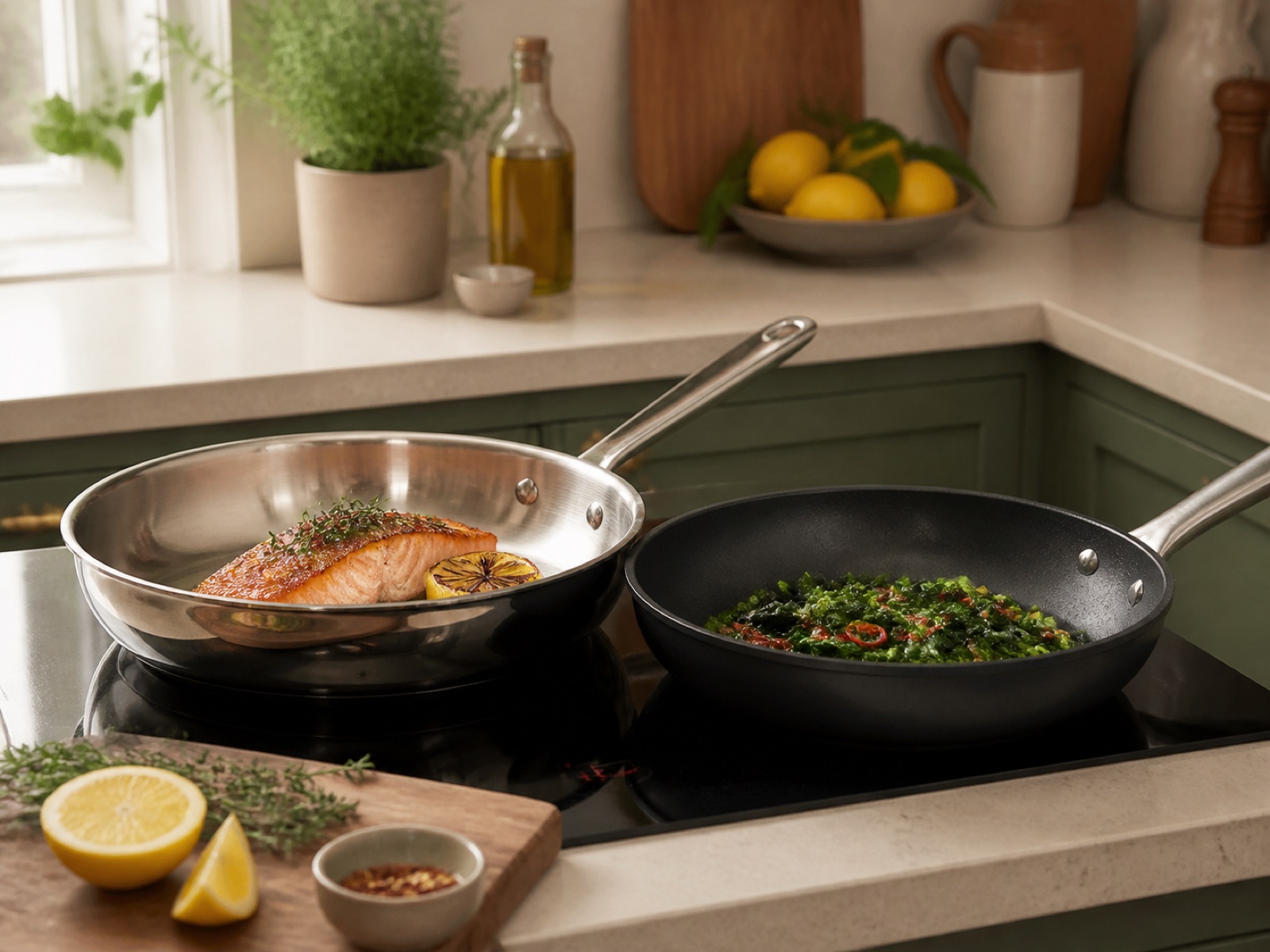
Choose stainless steel if you want strong browning, pan sauces and a pan you can use for a wide range of jobs. Choose non-stick if eggs, pancakes, delicate fish and easy cleaning matter most. For many kitchens, the most useful answer is one stainless-steel frying pan plus one smaller non-stick pan.
That short answer hides an important detail: these pans do not simply offer different levels of quality. They reward different cooking styles. Stainless steel gives you control and versatility but asks you to learn heat and timing. Non-stick reduces friction, literally and figuratively, but the coating needs gentler heat, suitable utensils and more careful storage.
This guide compares the two materials by the decisions that affect everyday cooking: food release, browning, heat, cleaning, induction compatibility, oven use and long-term value. It does not rank individual pans, and we have not presented manufacturer specifications as hands-on test results.
Stainless steel vs non-stick at a glance
| Question | Stainless steel | Non-stick |
|---|---|---|
| Best for | Searing, browning, sautéing, pan sauces and acidic foods | Eggs, pancakes, delicate fish and lower-fat everyday cooking |
| Food release | Depends on preheating, oil, dryness and patience | Easy when the coating is in good condition |
| Browning | Excellent for developing fond and colour | Usually less aggressive; high heat may be restricted |
| Learning curve | Moderate | Low |
| Utensils | Generally tolerant, although sharp tools can mark the finish | Wood, silicone or suitable plastic are safest unless the maker says otherwise |
| Cleaning | May need soaking or deglazing after searing | Usually quick, with a soft sponge |
| Induction | Often compatible, but check the exact pan | Only if it has a suitable magnetic base |
| Oven and grill | Often more versatile, subject to handle and lid limits | Limits vary; many coatings and handles have lower maximum temperatures |
| Wear | No coating to wear away | Release performance can decline as the coating wears |
What are you actually buying?
A stainless-steel pan is not necessarily a single sheet of steel. Many better frying pans use layers: stainless steel provides the cooking surface and durable exterior, while aluminium or another conductive material forms part of the base or core to spread heat. Words such as tri-ply, three-ply or fully clad describe construction, not a universal performance grade. Compare the thickness, weight, usable cooking area and exact warranty rather than buying a layer count alone.
Non-stick describes the cooking surface rather than the whole pan. The body is commonly aluminium, sometimes with a bonded or encapsulated base for induction. Traditional non-stick coatings often use PTFE. Ceramic non-stick usually means a different coating applied over a metal pan; it is not a solid ceramic frying pan. Both types still need the care instructions for the exact model.
Choose stainless steel if you want browning and versatility
Stainless steel is particularly useful when you want colour on meat, mushrooms or vegetables. Food proteins and sugars can leave browned deposits, known as fond, on the cooking surface. After the food is removed, stock, wine or another liquid can loosen those deposits and turn them into a pan sauce. A non-stick pan is designed to minimise that attachment, so it is less naturally suited to this technique.
It is also a strong general-purpose choice for sautéing, reducing sauces and cooking tomato, wine or citrus-based dishes. Bare stainless steel has no release coating to protect. However, oven and grill compatibility still depends on the complete pan: handles, lids, bonded bases and decorative finishes can all change the stated limit.
The catch: stainless steel needs technique
Stainless steel is not naturally non-stick. The most common causes of sticking are a pan that has not been preheated appropriately, food that is very cold or wet, too little cooking fat, excessive heat, or trying to turn protein before a browned crust has released.
- Dry the food’s surface, especially meat or fish.
- Preheat the pan gradually over low-to-medium or medium heat, following its instructions.
- Add enough oil to cover the cooking area and allow it to warm.
- Add the food when the oil is ready; it should sizzle rather than scorch.
- Leave protein undisturbed until it releases more readily instead of forcing it up.
- Adjust the heat down if the fat smokes or food burns before browning.
These steps can make stainless steel much easier to use, but they will not turn every egg into a zero-fat, slide-around-the-pan demonstration. If breakfast is your main job, non-stick remains the simpler tool.
Choose non-stick for delicate foods and easier release
A sound non-stick surface makes foods such as fried eggs, omelettes, pancakes and delicate fish easier to turn with less risk of tearing. It can also reduce the amount of oil needed for release, although that does not mean every recipe should be cooked without fat. Fat still contributes flavour, browning and heat transfer.
The trade-off is care. High heat is rarely needed and may shorten coating life; some manufacturers specify low-to-medium heat for normal cooking. Avoid leaving an empty coated pan over a powerful burner. Match the hob ring to the base so flames do not climb the sides, and take particular care with fast-heating gas and induction hobs.
Wooden and silicone utensils are the safest default. A maker may permit certain metal tools, but knives, sharp edges and vigorous scraping are poor choices on a coated surface. Use a soft sponge for cleaning, let the pan cool first and place a protector between stacked pans.
Is PTFE non-stick cookware safe?
The most useful answer is based on intended use, not blanket reassurance or alarm. Germany’s Federal Institute for Risk Assessment (BfR) says adverse health effects are not expected from commercially available PTFE-coated cookware when it is used as intended. Its current guidance warns against strongly heating an empty coated pan: at about 360°C and above, PTFE can decompose and release hazardous gases. The BfR also says accidental ingestion of tiny particles from a scratched coating is not expected to harm health because PTFE is inert and is excreted unchanged.
That does not make a badly damaged pan pleasant or effective to cook with. If the coating is peeling, blistered, badly gouged or no longer releases food reliably, follow the maker’s replacement guidance. Do not use a coated frying pan directly over an open barbecue flame unless the manufacturer explicitly permits it.
What about ceramic non-stick?
Ceramic-coated pans are often marketed as an alternative to PTFE. The label still tells you too little on its own. Check what the coating is applied to, whether the base works on your hob, the maximum oven temperature, permitted utensils and the warranty exclusions. A ceramic coating is still a coating, so gentle heating and non-abrasive cleaning remain sensible unless the instructions say differently.
Do not assume that “PFOA-free”, “PFAS-free”, “PTFE-free” and “ceramic” mean the same thing. They describe different chemicals or claims. If coating composition matters to you, look for an explicit statement from the manufacturer for the exact product rather than relying on a marketplace title.
Which pan works best for common foods?
- Steak and chops: stainless steel is better suited to building a deep sear and a pan sauce.
- Chicken thighs: stainless steel handles browning and deglazing well; wait for the skin to release.
- Eggs and omelettes: non-stick is the easier and more forgiving choice.
- Pancakes and crêpes: non-stick makes turning and batch cooking straightforward.
- Delicate fish: non-stick reduces the chance of tearing, although experienced cooks can use stainless with good temperature control.
- Mushrooms and onions: stainless steel is useful when colour and fond matter.
- Tomato sauces: uncoated stainless steel is a dependable, non-reactive choice.
- One-pan oven dishes: stainless steel often offers more flexibility, but verify the complete pan’s oven limit.
Induction, oven and dishwasher checks
Neither material label guarantees induction compatibility. Some stainless steels are magnetic and some are not; many stainless pans use a magnetic exterior layer. Aluminium non-stick pans need a compatible magnetic base. Look for the induction symbol on the exact product. A fridge magnet sticking firmly to a pan’s base is a useful screening check, but the manufacturer’s hob list is the deciding specification.
Oven safety is equally model-specific. A stainless-steel body may tolerate heat that a handle, lid knob or non-stick coating cannot. Check both the temperature and whether the pan is approved for a grill or broiler. Removable silicone grips should not be assumed oven-safe.
“Dishwasher safe” does not always mean “dishwasher preferred”. Repeated dishwasher cleaning can discolour cookware or reduce the release performance of some non-stick surfaces. Hand washing a cooled pan with warm water, mild washing-up liquid and a suitable sponge is the cautious default. Follow the product manual if it differs.
Size, weight and shape matter as much as material
Pan size is usually measured across the top rim, not the flat area that touches food. Two 28cm pans can therefore offer different usable cooking areas. A broader flat base gives ingredients more room to brown instead of steaming, but it also needs a suitably sized hob zone.
Weight affects comfort and stability. A multi-layer stainless pan may feel reassuringly solid but tiring to lift one-handed. A lighter aluminium non-stick pan is easier to toss, yet very light construction may feel less stable. If possible, handle the pan with its lid fitted and imagine it containing food. Check the helper handle on larger sauté pans.
Cleaning and long-term care
Stainless steel
- Let the pan cool before washing to reduce the risk of warping.
- Use warm water, washing-up liquid and a non-abrasive sponge for routine cleaning.
- Deglaze while cooking or soak stubborn residue rather than attacking a hot pan.
- A little diluted white vinegar can help with rainbow discolouration where the maker permits it.
- Add salt after liquid is hot or boiling if the instructions warn about cosmetic pitting.
Non-stick
- Keep to the manufacturer’s heat range and avoid empty preheating unless instructed.
- Use non-scratching utensils and cleaning tools.
- Avoid aerosol cooking sprays if the manufacturer warns they can leave a performance-reducing residue.
- Protect the cooking surface when pans are stacked.
- Inspect the surface periodically and replace a pan that is peeling, blistered or performing poorly.
Which setup should you buy?
Buy stainless steel first if you cook meat, sauté vegetables, build sauces, move pans between hob and oven, or want to master one highly versatile surface.
Buy non-stick first if your routine is dominated by eggs, pancakes, fragile fish, quick breakfasts or low-effort cleanup and you are happy to use moderate heat and gentle tools.
Buy one of each if you want the least compromise. A larger stainless-steel pan can handle searing, sautéing and sauces. A smaller non-stick pan can take care of eggs and delicate portions. This is often more useful than buying a large matching set in one material.
Buying checklist
- What do you cook at least twice a week?
- Do you want strong browning or effortless release?
- Will the flat cooking area hold your normal portions without crowding?
- Is the base compatible with your exact hob?
- What is the complete pan’s oven limit, including handle and lid?
- Which utensils and cleaning methods does the manufacturer permit?
- Can you comfortably lift and control it when full?
- Does the warranty cover the body, coating and handles in the way you expect?
- Would two targeted pans serve you better than a matching set?
The Completely Tasty verdict
Stainless steel is the stronger all-round choice for confident browning, deglazing and long-term versatility. Non-stick is the better specialist for delicate foods and low-friction everyday cooking. Neither one replaces the other perfectly.
If you only want one pan and are willing to learn heat control, choose a well-constructed stainless-steel frying pan. If easy eggs and fast cleanup are non-negotiable, choose a sensibly sized non-stick model and treat its coating gently. If space and budget allow, one of each is the most practical kitchen.
Frequently asked questions
Can stainless steel ever be non-stick?
It can release many foods cleanly with correct preheating, enough oil and patience, but bare stainless steel does not have a permanent non-stick coating. Eggs and very delicate foods remain less forgiving.
Is stainless steel better than non-stick for steak?
Usually, yes. Stainless steel is well suited to building a browned crust and leaving fond for a sauce. Dry the steak, preheat gradually, use suitable oil and let the meat release before turning.
Should I throw away a scratched non-stick pan?
A light mark is different from a coating that is peeling, blistered or badly gouged. The BfR says accidentally swallowed tiny PTFE particles are not expected to harm health, but a damaged surface may cook poorly. Follow the manufacturer’s inspection and replacement guidance.
Can I use metal utensils on stainless steel?
Stainless steel is generally more tolerant of metal utensils than a coated pan, although sharp edges and aggressive scraping can leave cosmetic marks. Use the care instructions for the pan’s finish.
Are all stainless-steel pans induction compatible?
No. Induction requires a compatible magnetic base. Many modern clad pans have one, but the words “stainless steel” alone are not proof. Check the induction symbol or specification for the exact model.
Do non-stick pans need oil?
Not always for release, but a small amount can improve flavour, colour and heat transfer. Check the instructions: some manufacturers discourage aerosol sprays because residue can build up on the coating.
What size frying pan is best for two people?
A 24cm or 26cm pan often suits smaller portions, while 28cm gives more room for browning and batch cooking. Compare the flat cooking diameter, not just the rim measurement, and make sure it matches your hob zone.
Research note
This guide was checked against current official guidance from the German Federal Institute for Risk Assessment on PTFE-coated cookware, Tefal cookware instructions, Le Creuset UK care and use guidance and All-Clad care and use guidance. Product limits vary, so the manual supplied with your pan takes priority.
Continue exploring our kitchen Buying Guides for practical comparisons built around how you cook.