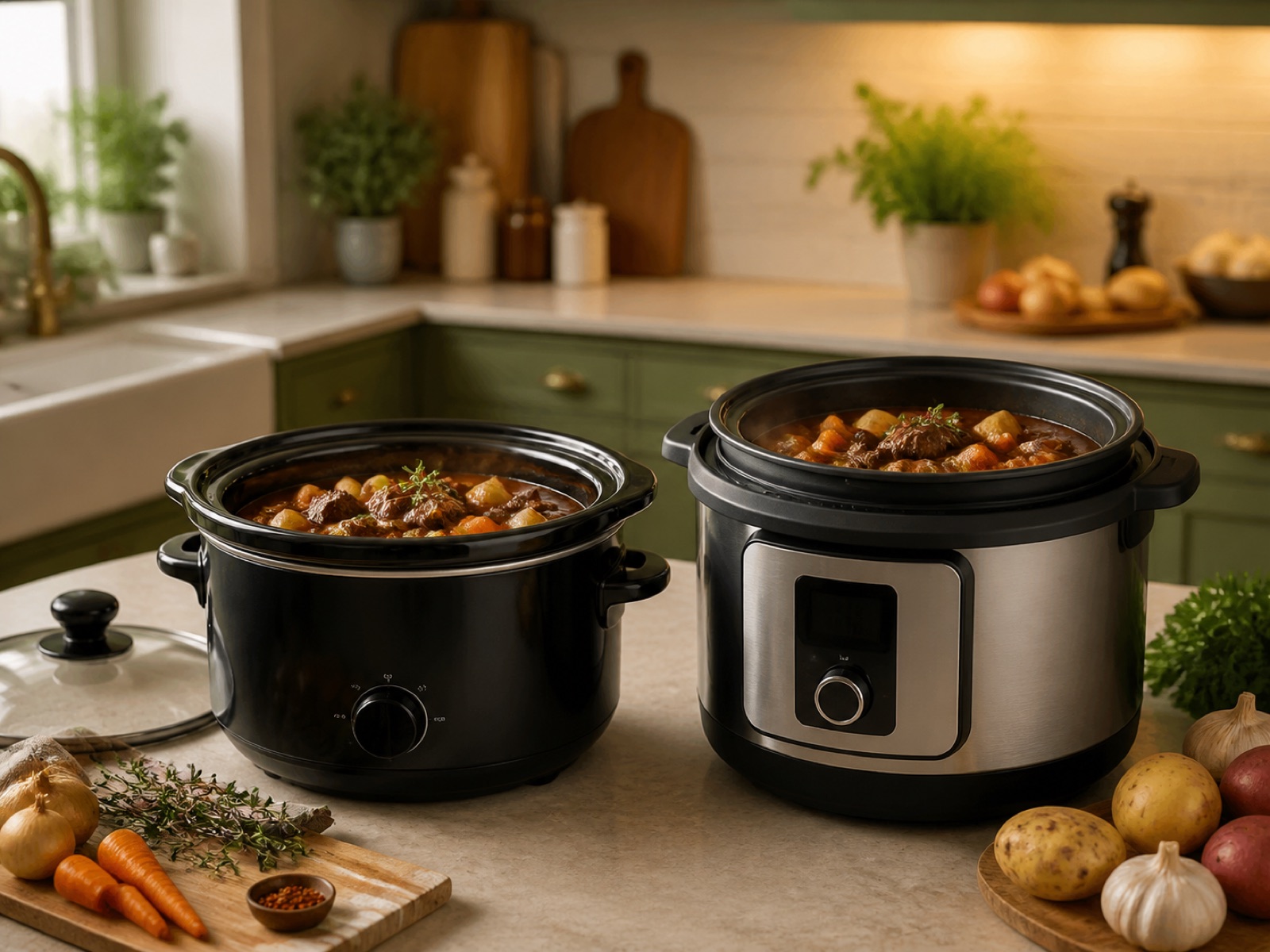
Completely Tasty appliance comparison
Choose simplicity for slow cooking or versatility for a busier kitchen
Quick verdict: buy a dedicated slow cooker if you mainly want stews, curries, casseroles and pulled meats with simple controls and minimal learning. Choose a multi-cooker if you will genuinely use pressure cooking, sautéing, steaming or rice programmes and want several jobs handled by one appliance.
A slow cooker and a multi-cooker can both produce tender one-pot meals, but they solve different problems. The slow cooker makes long, gentle cooking straightforward. A multi-cooker adds speed and flexibility, usually with more controls, a heavier lid and extra parts to understand.
The better choice is not automatically the machine with the longest feature list. It is the one that suits the meals you actually cook, the time you have before dinner and the amount of equipment you want to store.
What is the difference?
A dedicated slow cooker heats a removable cooking pot gradually over several hours. Typical controls are Low, High and Keep Warm, although programmable models may add timers or automatic schedules. Many use a ceramic or stoneware crock and a glass lid that lets you see the food without opening it.
An electric multi-cooker combines several programmes in one base. Pressure cooking is normally the defining extra, alongside functions such as slow cook, sauté, steam, rice and keep warm. Some models also bake, air-fry, dehydrate or make yoghurt. The exact list, and which lid or valve position each programme needs, varies considerably.
| Question | Dedicated slow cooker | Multi-cooker |
|---|---|---|
| Best for | Simple, unattended low-and-slow meals | Faster pressure cooking and several cooking methods |
| Typical controls | Low, High and Keep Warm | Programme panel, time, temperature and pressure settings |
| Cooking speed | Usually measured in hours | Pressure recipes can be much faster, but include pressurising and release time |
| Browning | Often needs a separate pan; some metal-pot models can sear | Often has a sauté or sear function in the cooking pot |
| Checking food | Usually easy through a glass lid | Pressure lid stays locked until safely depressurised |
| Learning curve | Low | Moderate, especially for pressure and steam release |
| Storage | Simple shape but sometimes a heavy crock | Often taller and heavier, with seals, racks or extra lids |
| Cleaning | Pot and lid, subject to the manual | Pot, lid, sealing ring, valves and programme-specific accessories |
Choose a slow cooker if…
- You want to load ingredients in the morning and serve a familiar one-pot meal later.
- You prefer a small number of clearly labelled controls.
- Your regular meals are stews, chilli, curry, soup, braised dishes or pulled meat.
- You like seeing the food through a glass lid.
- You do not need pressure cooking, rice programmes or appliance-based sautéing.
- You want an affordable second appliance rather than a replacement for several others.
Dedicated slow cookers are particularly easy to understand. A compact model can offer Low, High and Keep Warm without a menu system. Larger programmable models may add an automatic finish time, but their purpose remains focused.
Choose a multi-cooker if…
- You often reach dinner time without the six to eight hours a traditional recipe might require.
- You want to brown onions or meat, cook and keep warm in one removable pot.
- You will use pressure cook, steam, rice or yoghurt functions, not simply admire them on the box.
- You want one appliance to replace several separate machines.
- You are comfortable learning how the sealing ring, pressure valve and release methods work.
- Your cupboards can accommodate the appliance and its accessories.
Pressure cooking is the meaningful difference. A sealed pot uses pressurised steam to cook at a higher temperature than an open simmer, shortening many recipes. Remember that the displayed cooking time may not include the time needed to build pressure or release it afterwards. A “20-minute” programme is therefore not always a 20-minute dinner.
Which meals suit each appliance?
Meals that favour a slow cooker
Slow cookers suit dishes that benefit from gentle heat, plenty of moisture and a forgiving serving window. Think beef stew, lentil dhal, chilli, pulled pork, braised chicken thighs, soup and slow-cooked tomato sauces. They work well when preparation time is available earlier in the day and dinner time is predictable.
Delicate vegetables, lean meat and dairy can still require careful timing. “Leave it all day” is not a universal recipe instruction. Use a recipe developed for slow cooking, respect the appliance fill level and check that food is thoroughly cooked before serving.
Meals that favour a multi-cooker
A multi-cooker is stronger when time is short or the recipe benefits from distinct stages. You can often sauté aromatics, add liquid, pressure-cook beans or tougher meat, then reduce the sauce using the same pot. Rice, steamed vegetables, stock and batch-cooked pulses can also suit the format.
Pressure cooking is not automatically better for every dish. It limits evaporation while sealed, so sauces may finish thinner than expected. Fragile ingredients can overcook quickly, and you cannot taste or stir the food until the pressure has been released safely.
Do not buy by programme count alone. Ten named buttons can share the same basic heating behaviour. Look for the functions you will use, the control they provide and whether the instructions are clear.
Can a multi-cooker replace a slow cooker?
Sometimes, but not perfectly in every kitchen. Many multi-cookers include a Slow Cook programme, and manufacturers describe it as lower-temperature cooking over a longer period. That makes it useful for many casseroles, soups and braises.
However, a programme with the same name does not guarantee identical results. A traditional crock may heat around the sides as well as beneath the food, while a multi-cooker may use a metal pot and a different heat pattern. Lid fit, pot shape, temperature settings and evaporation also affect the result.
If slow cooking is your main purpose, a dedicated machine is the safer, simpler purchase. If slow cooking is one of several methods you want, check independent tests and the manual for the exact multi-cooker rather than assuming the button duplicates a traditional crock.
Browning, texture and flavour
Browning meat and vegetables can deepen flavour before liquid is added. Many basic slow cookers cannot safely go on the hob, so browning requires a frying pan. Some newer models use a removable metal bowl that the manufacturer identifies as hob-safe; never put stoneware on a hob unless the instructions explicitly permit it.
Multi-cookers commonly provide Sauté or Sear in the main pot. This reduces washing up and keeps browned residue in the final dish. The trade-off is working inside a deep pot, which can make it harder for moisture to escape. Brown in batches rather than overcrowding the base.
Capacity and useful shape
Capacity in litres is only the starting point. A wide oval slow-cooker crock may fit a joint or whole chicken differently from a tall, round multi-cooker pot. Compare internal dimensions, the manufacturer’s maximum-fill marks and the food you intend to cook most often.
Do not assume the headline capacity is fully usable. Pressure cooking and expanding foods require space above the ingredients. Electrical Safety First notes that typical limits can be lower for pressure cookers than slow cookers and lower again for foods such as grains, but the markings and manual for your exact appliance take priority.
Energy use: compare the whole recipe
It is tempting to declare one format cheaper to run, but wattage alone cannot answer the question. A slow cooker may draw less power while operating for many hours. A pressure programme may draw more power for a shorter period and also spend time heating and releasing pressure.
For a meaningful comparison, measure total electricity used for the same quantity and recipe. An energy monitor can show kilowatt-hours from switch-on to serving. Multiply that figure by your current electricity unit rate. Include any separate hob browning and final sauce reduction. Without that like-for-like test, broad percentage-saving claims are marketing rather than a dependable household forecast.
Controls, cleaning and storage
A manual slow cooker is hard to beat for immediacy: select Low or High and leave the recipe to cook. A digital timer is helpful when it automatically changes to Keep Warm, although Keep Warm is for holding cooked food, not for slowly bringing raw ingredients to a safe temperature.
A multi-cooker requires more initial reading. Pressure and non-pressure programmes may use different valve positions, lid arrangements or minimum liquid levels. The sealing ring and anti-block components must be clean and correctly installed. Once learned, saved presets and one-pot sautéing can make repeated meals efficient.
For cleaning, check every component rather than relying on a general “dishwasher safe” claim. A slow cooker may have a washable crock and lid. A multi-cooker can add a sealing ring, valve cover, condensation collector, rack and crisping accessories. The base, cable and plug must never be immersed.
Measure storage before buying. Include lid height, handle width and ventilation clearance, not just the footprint. A multi-cooker that replaces a rice cooker and steamer may save cupboard space overall; one that duplicates appliances you already use will not.
Safety differences that matter
- Use a heat-resistant surface: allow the clearance stated in the manual and keep the cable away from hot edges.
- Respect fill limits: overfilling can affect cooking and, in a pressure cooker, block pressure-control parts.
- Pressure lids stay closed: never force one open. Follow the specified natural or quick-release method and keep hands and face away from steam.
- Check seals and valves: use the correct original sealing ring, seat it properly and clear debris as the manual directs.
- Follow unattended-use guidance: Electrical Safety First advises using a slow cooker’s High setting only while you are at home. Model instructions take priority.
- Inspect the electrics: stop using the appliance if the plug, socket or cable becomes unusually hot, marked or damaged, or if you notice sparking, buzzing or an electrical smell.
Three common buying scenarios
“I want dinner ready after work with almost no learning”
Choose a programmable slow cooker with Low, High, Keep Warm and a timer. Prioritise the right crock shape, clear controls and parts you are comfortable cleaning.
“I batch-cook beans, stock, curry and tougher cuts”
A pressure-capable multi-cooker is likely to provide more useful flexibility. Look for an easy-to-clean stainless or coated pot, clear pressure-release controls, replaceable seals and a sauté mode with useful temperature adjustment.
“I mainly want slow cooking but might try pressure cooking”
Be honest about which habit will dominate. If you already avoid complicated controls, the extra programme may go unused. If faster weeknight cooking solves a real problem, the learning time could be worthwhile. Download the manual before buying and see whether the process feels manageable.
Buying checklist
- List the five meals you expect to make most often.
- Decide whether pressure cooking solves a real timing problem.
- Check usable capacity, pot shape and maximum-fill markings.
- Measure the worktop and storage space, including lid clearance.
- Read the manual for valve positions, minimum liquid and cleaning.
- Check replacement pots and sealing rings are available.
- Confirm the UK plug, guarantee and retailer’s returns policy.
- Ignore programmes you cannot connect to a meal you already cook.
The Completely Tasty verdict
A slow cooker is the better specialist; a multi-cooker is the better generalist. Choose the specialist when low-and-slow meals are the whole point. Choose the generalist when pressure cooking and one-pot sautéing will change how often you cook at home.
Whichever format you choose, buy for your regular meals rather than the longest specification sheet. You can explore the rest of our practical kitchen buying guides as this new appliance section grows.
Affiliate disclosure: If you buy through the link below, Completely Tasty may earn a commission at no extra cost to you.
Compare current Ninja multi-cookers
Use the criteria in this guide to compare current Ninja cooking modes, capacities and formats. This range link is not a claim that every model will suit your kitchen.
Prices, models and availability can change. Check the retailer page before buying.
Frequently asked questions
Is an Instant Pot the same as a multi-cooker?
Instant Pot is a brand of electric multi-cooker. Other manufacturers also make multi-cookers with pressure, slow-cook, sauté and additional programmes. Features vary by model.
Does a multi-cooker slow-cook as well as a Crock-Pot?
It can produce good slow-cooked meals, but results are not guaranteed to be identical. Pot material, heating pattern, lid and temperature settings differ. Check tests and instructions for the exact model.
Can I leave a slow cooker on while I am out?
Follow the manufacturer’s instructions and current electrical-safety advice. Electrical Safety First recommends using Low if leaving the house and reserving High for when you are at home. Keep the appliance on a heat-resistant surface with the required clearance.
Can I open a multi-cooker during pressure cooking?
No. A pressure lid remains locked while the pot is pressurised. Use the release method specified by the recipe and manual, wait for pressure to fall, and never force the lid.
Which is easier to clean?
A basic slow cooker usually has fewer components. Multi-cookers add seals, valves and sometimes several accessories. Dishwasher compatibility varies, so inspect the cleaning instructions before buying.
Which is better for a small kitchen?
A small slow cooker has the simplest footprint. A multi-cooker may save more total space only if it replaces appliances you would otherwise own. Measure the machine with its lid open and count every accessory.
Research note: guidance was checked on 6 August 2026 against Electrical Safety First slow and pressure cooker advice, official Crock-Pot slow-cooker information, the Instant Pot UK pressure-cooking explainer, official Ninja Foodi multi-cooker guidance and the UK Food Standards Agency’s cooking guidance. Functions and safety instructions vary by model; the manual for your appliance takes priority. This category guide contains no affiliate links and does not claim hands-on product testing.