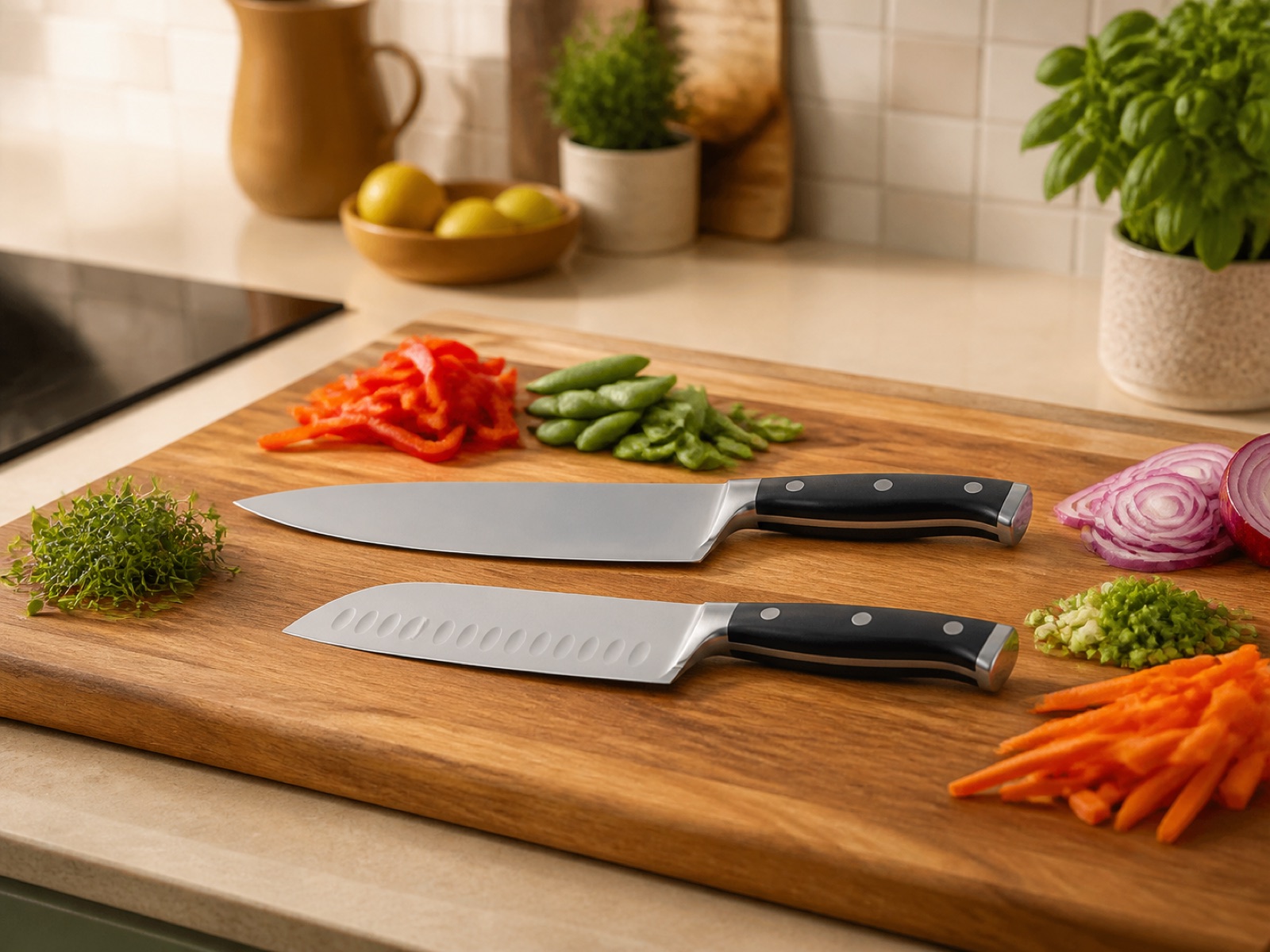
Choose a chef’s knife if you like a rocking cut, regularly tackle larger ingredients and want a pointed all-rounder with plenty of reach. Choose a santoku if you prefer straighter push cuts, use a compact board or want a shorter, often lighter blade with useful knuckle clearance.
Both can be the main knife in a home kitchen. The better choice is not decided by whether one style is “Western” and the other “Japanese”; it comes down to the exact blade, your hand, your cutting motion and the food you prepare most often.
This guide compares the two shapes by blade profile, length, board space, tip control, weight, food release, sharpening and care. It does not rank individual knives, and manufacturer descriptions are not presented as hands-on test results.
Chef’s knife vs santoku at a glance
| Question | Chef’s knife | Santoku |
|---|---|---|
| Typical profile | Pointed tip with a more curved cutting edge | Lower tip with a straighter or gently curved edge |
| Common length | About 20cm is common, with shorter and longer choices | Often about 16–18cm, with compact versions available |
| Natural motion | Rocking, slicing and some push cutting | Push cutting, chopping and slicing |
| Tip work | Longer pointed tip can help with detailed cuts | Lower tip is capable but feels different in tight work |
| Large ingredients | Extra length can help with cabbage, squash and large joints | Compact length is nimble but may need more strokes |
| Board space | Needs room for the blade and rocking movement | Usually comfortable on a smaller board |
| Ingredient transfer | Varies with blade height | Broad blade is often convenient for lifting chopped food |
| Weight | Ranges from light stamped knives to substantial forged models | Often lighter, but not universally |
| Best fit | Cooks wanting reach, rocking and a versatile point | Cooks wanting compact control and straighter cuts |
What is a chef’s knife?
A European-style chef’s knife normally has a pointed tip and a curved section along the cutting edge. That curve supports a rocking action: part of the edge stays near the board while the handle rises and falls. A blade around 20cm is a familiar all-purpose size, but 15cm, 18cm, 23cm and longer versions exist.
The length gives useful reach for large onions, cabbage, squash and portions of meat. The tip can handle scoring, trimming and precise cuts. A deeper curve also makes repeated herb chopping feel natural to cooks who already use a rocking technique.
Do not assume every chef’s knife is thick or heavy. Construction, steel, taper, bolster and handle make a major difference. Stamped knives can be light and slim; forged knives may be substantial or carefully tapered. The category describes a shape, not one standard weight or level of quality.
What is a santoku?
Santoku is commonly translated as “three virtues” or “three uses”, reflecting its role as a multipurpose knife for meat, fish and vegetables. The blade is generally broad, with a lower spine that curves down towards the tip and a cutting edge that is straight or only gently curved. Many models are around 16–18cm long.
That profile encourages a forward-and-down push cut or a more vertical chop. The wide blade can give useful knuckle clearance and makes it easy to gather diced vegetables, using the spine or another suitable tool rather than dragging the sharp edge sideways across the board.
Some santokus have oval hollows or scallops along the sides. Many do not. Some are very light and thin; others are forged, weighty and shaped to permit more rocking. The exact product matters more than a rule that begins with “all santokus”.
The biggest difference: cutting motion
Choose a chef’s knife for rocking
If you keep the front of the edge close to the board and lift the heel repeatedly, a chef’s knife usually provides the more natural platform. The curved belly gives the blade room to travel through the arc. This can be useful for herbs, a pile of finely chopped vegetables or any routine in which you already work with a smooth rocking rhythm.
Choose a santoku for push cutting
If you move the blade forward and down, then lift it clear to reset, a flatter santoku edge can put more of the blade in contact with the board at once. This suits clean slices and orderly chopping. Trying to force a pronounced rocking motion from a very flat edge can leave the heel or middle failing to contact the board cleanly.
These are tendencies, not restrictions. Many chef’s knives push cut well, and some modern santokus have enough curve for gentle rocking. Watch how you naturally chop an onion; your existing motion is more useful evidence than a label on the box.
Blade length, board size and control
A longer blade is not automatically better. It can cross a large cabbage in fewer strokes and give a longer draw when slicing meat, but it also needs a board with enough depth and a cook who feels in control of the tip. A shorter santoku often feels nimble in a small kitchen, particularly for everyday vegetables and boneless portions.
Measure your usable board, not the space you wish you had. The blade should move without the handle, knuckles or tip striking a wall, appliance or raised rim. If a 20cm chef’s knife feels cumbersome, an 18cm chef’s knife may solve the problem just as effectively as switching categories.
Blade height matters too. More height at the heel can create knuckle clearance and a broad surface for guiding food, but cooks with smaller hands may find a very tall blade less precise. Check that your knuckles clear the board when your grip is relaxed rather than artificially raised.
Which is better for common kitchen jobs?
- Onions, carrots and peppers: both work well; choose by preferred motion and blade height.
- Herbs: a curved chef’s knife suits rocking, while a santoku suits deliberate push cuts that can reduce repeated bruising from over-chopping.
- Large cabbage or squash: a longer, suitably sturdy chef’s knife may offer more reach. Neither knife should be forced through hard material if the maker excludes the task.
- Boneless meat and fish: both can slice and portion effectively; a longer edge may help with a smooth draw cut.
- Fine vegetable slices: a thin santoku can feel precise, but grind and sharpness matter more than nationality.
- Garlic and shallots: either works; a chef’s knife offers a familiar pointed tip, while a santoku’s broad face is convenient for gathering the result.
- Bones and frozen food: use a tool designed for the job. A general-purpose chef’s knife or santoku can chip, bend or slip when forced.
Do santoku hollows stop food sticking?
Hollows, sometimes called grantons, scallops or a hollow edge, are intended to reduce contact, drag or adhesion between food and blade. They can help in some cuts, but they do not create a non-stick surface. Moist potato, cheese and other foods may still cling.
A chef’s knife can also have hollows, and a santoku can have a smooth face. Treat them as one design feature rather than the reason to choose the entire knife. Blade finish, geometry, cutting speed and the ingredient all affect release.
Steel, hardness and edge geometry
Steel type and hardness influence how a knife takes and holds an edge, resists corrosion and responds to rough use. Harder is not simply better: a hard, thin edge may retain sharpness well but can be less forgiving of twisting, impact or an unsuitable chopping surface. A tougher, softer blade may need more frequent edge maintenance but tolerate everyday knocks differently.
Rockwell hardness figures are useful only alongside the steel, heat treatment, edge thickness and intended use. Likewise, a quoted sharpening angle applies to that model, not to every santoku or chef’s knife. Follow the manufacturer’s angle and sharpening method rather than applying a universal number.
Single bevel or double bevel?
Most mass-market chef’s knives and santokus sold to UK home cooks are sharpened on both sides, but specialist Japanese knives may use different geometries. Confirm the specification, particularly if you are left-handed or buying a sharpener with fixed guides. Do not assume “Japanese” means single bevel or that “Western” defines one angle.
Forged versus stamped: not a shortcut to quality
A forged knife is shaped through a forging process and may include a substantial bolster. A stamped knife is cut from sheet material and is often lighter. Either can be well made. Heat treatment, grind, handle fit, balance, finishing and quality control matter alongside the manufacturing method.
A full bolster can provide a familiar transition and forward weight, but it may complicate sharpening the heel over time. A half bolster or bolster-free design can expose the full edge. Choose the feel and maintenance arrangement you understand rather than paying for “forged” as a prestige word.
Handle, grip and balance
A good knife should feel secure without a white-knuckle grip. Try a pinch grip with thumb and forefinger near the blade, then a handle grip if that is how you cook. Look for pressure at the index finger, heel of the hand and little finger. Check whether the spine and bolster have comfortable edges.
Balance is personal. Some cooks like weight forward for confident chopping; others prefer neutral balance near the pinch point. Total weight alone cannot tell you how the knife will feel. Handle shape, blade height and balance point interact, so trying the knife safely is more valuable than comparing grams online.
Sharpening, honing and everyday care
A sharp knife is easier to control than a dull one because it needs less force, but sharpening must match the blade. A honing rod can realign some edges; it does not replace removal of metal when the edge is genuinely blunt. Harder or thinner blades may require a ceramic rod, whetstone or professional service instead of a traditional grooved steel. Follow the maker’s instructions.
- Cut on a suitable wooden, wood-fibre or plastic board rather than glass, stone, ceramic or a worktop.
- Wash promptly with mild washing-up liquid and dry carefully. Even when a model is labelled dishwasher safe, many manufacturers recommend hand washing.
- Do not leave a knife loose in a sink where the edge is hidden.
- Store it in a block, rack, sheath or drawer insert that protects the edge and your hands.
- Use the spine, not the sharp edge, to move chopped food across the board.
- Do not twist the blade through hard food or use it as a screwdriver, tin opener or cleaver.
Which setup should you buy?
Choose a chef’s knife if you have a generous board, like rocking herbs, want extra reach for large ingredients or rely on a pointed tip for detailed work.
Choose a santoku if you mainly chop vegetables and boneless proteins, prefer push cuts, want a compact blade or value the feel of a broad, relatively straight profile.
Choose the better-fitting model regardless of category if one handle, weight and length immediately feels more controlled. A comfortable 18cm chef’s knife is a better purchase than an awkward santoku bought for its label, and vice versa.
A five-minute shop test
- Use the grip you actually cook with and check for pressure points.
- Hold the knife in a safe working position and assess whether the tip feels controlled.
- Check knuckle clearance at the heel.
- Mime your normal rocking or push-cut motion over a display board, with permission.
- Compare the usable blade length with your board and largest regular ingredient.
- Ask for the exact steel, hardness, edge angle, bevel, dishwasher guidance and warranty.
- Confirm what sharpening method the manufacturer supports.
- Buy a safe storage solution and suitable chopping board if you do not already have them.
The Completely Tasty verdict
A chef’s knife is the stronger default for cooks who want length, a pronounced rocking action and versatile tip work. A santoku is the better fit for cooks who value a compact footprint, straight push cuts and a broad blade for everyday vegetable preparation.
The overlap is much larger than the marketing suggests. Either can be your main kitchen knife. Start with cutting motion and fit, then compare the exact blade length, height, steel, edge, weight and maintenance instructions. If you can safely try both, your hand will often settle the question faster than a specification table.
Frequently asked questions
Is a santoku better than a chef’s knife for beginners?
Not automatically. A shorter santoku can feel manageable on a small board, while a chef’s knife may feel more familiar to someone taught a rocking technique. Safe grip, sharpness and fit matter more than experience level.
Can a santoku replace a chef’s knife?
For many home cooks, yes. It handles vegetables, boneless meat, fish and herbs. A longer chef’s knife may still be more convenient for large ingredients, long slicing strokes or pronounced rocking.
Can you rock-chop with a santoku?
Some santokus have enough curve for a gentle rocking action, while flatter models favour push cutting. Inspect the edge profile rather than assuming from the name.
Why do some santokus have dimples?
The hollows are intended to reduce friction or food adhesion. They may help with some ingredients but do not stop everything sticking, and they are not unique to santokus.
What length chef’s knife should I buy?
Around 20cm is a common starting point, but 15–18cm can suit smaller hands and boards. Choose the longest blade you can control comfortably in your actual workspace, not the longest one on offer.
Can either knife cut through bone?
Do not assume so. General-purpose chef’s knives and santokus can chip, bend or slip when forced through bone or frozen food. Use a cleaver, poultry shears or another tool specifically approved for the task.
Should kitchen knives go in the dishwasher?
Check the exact knife. Some manufacturers label particular models dishwasher safe but still recommend hand washing; wooden handles may prohibit dishwashers entirely. Hand washing and prompt drying are the cautious default.
Do I need both a chef’s knife and a santoku?
No. Their jobs overlap heavily. Most kitchens gain more from one well-fitting all-purpose knife, a paring knife and a bread knife than from two similar general-purpose blades. Add the second only if its different length or motion solves a real need.
Research note
This guide was checked against current official guidance from Wüsthof on santoku design and cutting motion, Wüsthof on chef’s-knife profiles and uses, Zwilling UK on santoku shapes and model variation and Victorinox knife-care guidance. Exact angles, hardness, weight, dishwasher suitability and sharpening methods vary, so the instructions supplied with your knife take priority.
Continue exploring our kitchen Buying Guides for practical comparisons built around how you cook.