Completely Tasty appliance guide
Air fryer or mini oven? Start with the food you cook
Quick answer: choose an air fryer when your priority is crisp food in smaller portions with a simple basket. Choose a mini oven when you want a wider cooking area for toast, pizza, baking dishes and tray-based meals. Neither format is automatically better or cheaper for every household.
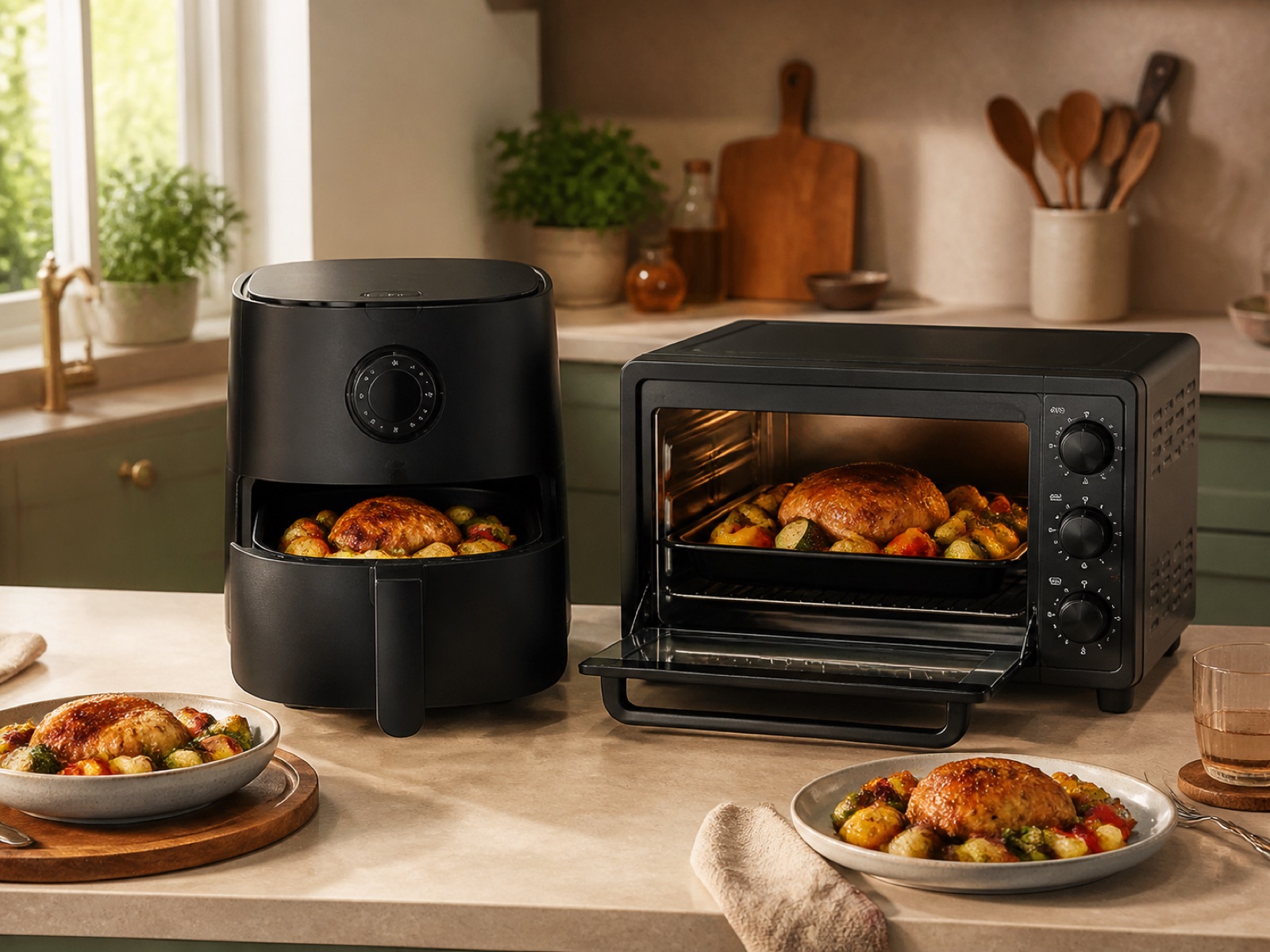
Air fryers and mini ovens can look like close substitutes. Both cook with electric heating elements, and many models circulate hot air with a fan. The practical difference is the shape of the cooking chamber. A basket air fryer concentrates heat around a compact basket, while a mini oven gives you an oven-style door, shelves and a wider tray.
That difference affects what fits, how easily you can check the food and how much cleaning is involved. This guide compares the two formats without pretending one appliance wins every category.
The quick verdict
An air fryer is likely to suit you if…
- You usually cook for one or two people.
- Crisp chips, roast vegetables, breaded food and reheated leftovers are priorities.
- You prefer a removable basket that can be shaken during cooking.
- You want a compact chamber for small, frequent portions.
A mini oven is likely to suit you if…
- You want to toast, bake and cook on flat trays.
- Pizza, open sandwiches, small casseroles or cake tins appear regularly.
- You value an oven-style window and easier visual checking.
- You need a wider cavity or more than one shelf position.
Air fryer vs mini oven at a glance
| Question | Basket air fryer | Mini oven |
|---|---|---|
| Cooking space | Deep, compact basket | Wider oven cavity with tray or rack |
| Best-known jobs | Crisping, roasting small portions, reheating | Toast, pizza, baking, gratins and tray meals |
| Checking food | Usually pull out the drawer | Usually look through the door |
| Preheating | Often short or unnecessary, depending on the recipe | Usually benefits from preheating for baking |
| Accessories | Basket, crisper plate, optional inserts | Rack, baking tray, crumb tray and sometimes grill pan |
| Cleaning | Basket and plate need regular washing | Tray, rack, crumb tray and interior need attention |
| Worktop needs | Drawer clearance in front | Door clearance plus ventilation around the oven |
How are they actually different?
“Air fryer” describes a cooking method and a product category, but the familiar drawer model is essentially a small fan oven built around a perforated basket. Air moves around the food, helping moisture escape and surfaces brown. The compact chamber is useful when you are not trying to fill a conventional oven.
A mini oven is shaped more like a scaled-down conventional oven. You slide food onto a rack or tray, choose a temperature and often select between bake, grill or fan-assisted modes. Some mini ovens advertise an air-fry function, but the wider cavity and tray layout still change how food is arranged. Crowding any appliance can restrict airflow, so usable surface area matters as much as the label on the box.
The Tasty Rule: compare the cooking surface and shape before comparing litre figures. A wide 20-litre oven cavity and a deep 5-litre basket are designed for different arrangements of food.
Capacity: litres do not tell the whole story
Manufacturers quote capacity in litres, but litres are not directly comparable across these two formats. As current examples, the Ninja Air Fryer Pro AF140UK has a 4.7-litre basket and external dimensions of 26.5 × 28.5 × 36cm. The Russell Hobbs Express Air Fry Mini Oven 26680 is listed at 20 litres and 33cm high. These examples illustrate the format difference; they are not product recommendations.
A basket can hold a generous pile of food, but a single layer usually browns more evenly than a crowded one. A mini oven may fit a small pizza, several slices of toast or a shallow baking dish because its floor area is wider. Before buying, measure the food or cookware you use most: dinner plates, cake tins, pizza diameter and the length of a fish fillet can be more informative than the capacity badge.
If you are leaning towards an air fryer, our air fryer size guide turns household size and meal type into a practical shortlist. If you are comparing drawer layouts, read single vs dual-drawer air fryers.
Which foods suit each appliance?
Jobs that favour a basket air fryer
Air fryers are at their most convincing when hot air can reach several sides of relatively small pieces. Think chips, wedges, roast vegetables, chicken pieces, sausages, breaded fish, reheated pizza slices and pastries. Pulling out the basket lets you shake or turn food quickly, although you should follow the appliance instructions and avoid overfilling.
Jobs that favour a mini oven
Mini ovens make sense for food that wants a flat, stable surface: toast, cheese on toast, a small pizza, baked pasta, open sandwiches, cookies or a cake tin that fits safely. An oven door and internal light can make it easier to watch browning. Rack positions also give you more control over the distance between food and the upper heating element.
The catch is that model capabilities vary. Do not assume every mini oven has a fan, a useful grill or enough clearance for a particular dish. Likewise, do not assume every air fryer can bake evenly just because a recipe uses the word “air fryer”. Check the manual, supplied accessories and internal dimensions.
Which uses less electricity?
There is no honest format-wide answer. Electricity use depends on power draw, cooking time, preheating, the amount of food and how often you open the appliance. Energy Saving Trust found an air fryer cheaper than a full-size electric oven for the same small tested meal, while noting that a full oven can make more sense when it is filled for batch cooking. That result compares an air fryer with a full-size oven; it does not prove that every air fryer costs less than every mini oven.
You can compare your own appliances with a plug-in energy monitor. Run the same meal from cold, weigh or count the same quantity of food and stop when the food reaches the same level of doneness. Record the kilowatt-hours shown by the meter. Repeat the test on another day to reduce the effect of small timing differences.
A rough upper-limit calculation is rated kilowatts × cooking hours = kilowatt-hours. For example, a 1.5kW appliance running continuously for 30 minutes would use 0.75kWh. Real thermostatic appliances cycle their heating elements, so a meter gives a better answer than rated wattage alone. Multiply measured kWh by the unit rate on your electricity tariff to estimate the cooking cost.
Speed and preheating
A small air-fryer basket normally heats quickly because there is less empty space around the food. For frozen chips, vegetables and reheating, that can shorten the whole process. A mini oven is still much smaller than a full-size oven, but baking often benefits from a proper preheat so the temperature is stable when the food goes in.
Do not judge speed by the timer alone. Include preheating, turning or shaking, cooking a second batch and the time required to bring the centre of the food to a safe temperature. A fast first basket is less convenient if you need three batches to feed everyone.
Worktop space and ventilation
Measure height, width and depth, then add the operating clearance required by the manual. An air-fryer drawer needs space to pull forward and a heat-resistant place to rest if you remove it. A mini-oven door swings down, and the top, sides and rear can become hot. Think about wall units above the appliance, nearby curtains, power-cable routing and whether steam or cooking vapour can escape.
Neither appliance should be squeezed into a cupboard while operating unless the manufacturer explicitly says that installation is safe. Place it on a stable, heat-resistant surface with its vents clear.
Which is easier to clean?
A basket air fryer usually has fewer large parts: a drawer, basket or crisper plate. Grease can collect beneath the plate, so washing only the visible cooking surface is not enough. Dishwasher compatibility varies by model and coatings can be damaged by abrasive pads.
A mini oven has more exposed interior space plus a rack, tray and crumb tray. Crumbs are easy to remove when the crumb tray slides out, but splashes on the walls and heating-element area can take longer. Russell Hobbs, for example, states that the removable parts supplied with its 26680 mini oven are not dishwasher safe. Always cool and unplug either appliance before cleaning, and follow its manual rather than a generic cleaning hack.
Choose by household and routine
- One person, quick lunches: a compact basket air fryer is often the simpler choice for one portion and reheating.
- Two people who love crisp food: an air fryer works well if the basket holds both portions in a loose layer.
- Toast, pizza and baking household: a mini oven’s flat tray and rack positions are likely to be more useful.
- Family meals: check whether either appliance can complete the full meal in one run. Multiple batches can remove the time and energy advantage.
- Kitchen without a usable main oven: a mini oven offers broader oven-style functions, provided its internal dimensions fit your cookware.
- Already own a good oven: an air fryer may add a more distinct small-portion option than another oven-shaped appliance.
A five-minute buying checklist
- Write down the five foods you expect to cook most often.
- Measure your largest regular item or cookware, not only your worktop.
- Check internal dimensions, shelf positions and usable basket area.
- Allow for the drawer or door to open and for the manual’s ventilation clearance.
- Read the cleaning instructions and check whether removable parts are dishwasher safe.
- Compare the warranty, replacement accessories and seller reputation.
- If energy is decisive, test with a plug-in meter rather than relying on marketing claims.
Safety basics
Buy from a reputable retailer, check for a UK plug and fuse, register the appliance where possible and follow the manufacturer’s instructions. Electrical Safety First advises keeping air-fryer cables away from hot surfaces, not overfilling the basket, keeping ventilation openings clear and not leaving the appliance unattended. The same common-sense approach applies to a mini oven: allow it to cool, keep hot doors and surfaces away from children and never immerse the appliance body in water.
The Completely Tasty conclusion
Pick the air fryer for smaller portions, frequent crisping and the convenience of a shakeable basket. Pick the mini oven for flat trays, toast, pizza, baking dishes and broader oven-style cooking. If both descriptions sound useful, prioritise the appliance that completes your most common meal in one run and fits safely in the space you have.
Continue with our independent buying guides, including how to choose an air-fryer size and whether a single or dual drawer fits your routine.
Affiliate disclosure: If you buy through the link below, Completely Tasty may earn a commission at no extra cost to you.
Compare current Ninja air fryers
Use the criteria in this guide to compare current Ninja capacities, drawer layouts and features. This range link is not a claim that every model will suit your kitchen.
Prices, models and availability can change. Check the retailer page before buying.
Frequently asked questions
Can a mini oven replace an air fryer?
A fan-assisted mini oven can handle many air-fryer-style foods, especially when it has a perforated basket or mesh tray. Results may differ because the cavity is wider and food sits farther from the heating elements. If crisping is your priority, compare airflow, tray design and real usable area.
Which is cheaper to run?
The cheaper appliance is the one that cooks the same meal to the same result with fewer measured kilowatt-hours. Small chambers can be efficient for small meals, but power, time, preheating and batch count all matter. A plug-in energy monitor gives the fairest comparison.
Which is better for pizza and toast?
A mini oven usually has the more convenient shape for a whole small pizza and several slices of toast. An air fryer can reheat pizza very well, but basket width may limit the size or require cutting.
Which is easier to clean?
Basket air fryers normally have fewer parts, while mini ovens add racks, trays and a larger interior. The easiest model is one with accessible surfaces and removable parts that match the way you prefer to wash up. Check the manual before using a dishwasher or abrasive cleaner.
Research note: specifications and guidance were checked on 6 August 2026 against the official Ninja AF140UK product page, Russell Hobbs 26680 product page, Energy Saving Trust cooking comparison and Electrical Safety First air-fryer advice. Product examples illustrate format and capacity only; they are not recommendations. This article contains no affiliate links.